Need Professional Hoarding Cleanup in Houston?
When a Loved One Leaves Behind a Hoarded Home
Losing a family member is difficult under any circumstances. When that loved one also struggled with hoarding disorder, the grief is compounded by the overwhelming task of dealing with a home filled to capacity with accumulated belongings. Many families in the Houston area find themselves facing this exact situation, often with little understanding of what the process involves or where to begin.
Similarly, when an aging parent or relative transitions to assisted living or long-term care, families may discover for the first time the true extent of hoarding in their loved one’s home. The shock of opening a door to rooms stacked floor to ceiling with belongings can be paralyzing, especially when combined with the emotional weight of the situation.
Understanding the Scope of an Estate Cleanout
A hoarded estate cleanout is fundamentally different from a standard estate sale or home cleanout. Standard estate services typically involve organizing, pricing, and selling belongings in a home that has been reasonably maintained. A hoarded home presents challenges that require specialized knowledge, equipment, and sensitivity.
Volume and Accessibility
Hoarded homes often contain enormous volumes of material, sometimes measured in tons rather than truckloads. Pathways may be narrow or nonexistent, rooms may be inaccessible, and items may be stacked in unstable configurations that create safety hazards. The sheer volume means that a cleanout that might take a day in a typical home can require a week or more in a hoarded property.
Hidden Hazards
Beneath the accumulated belongings, hoarded homes frequently conceal structural damage, mold growth, pest infestations, and in some cases biohazardous materials. These hazards may not be visible until the cleanout process is well underway, which is why professional assessment and proper protective equipment are important from the start.
Emotional Complexity
Every item in a hoarded home held meaning for the person who kept it. Family members conducting the cleanout may feel guilt about discarding their loved one’s possessions, especially items that clearly held sentimental value. This emotional dimension makes the process slower and more draining than a purely practical task.
The Process of a Respectful Estate Cleanout
Professional estate cleanout services that specialize in hoarded homes follow a structured process designed to be thorough, safe, and respectful of both the deceased and the surviving family.
Initial Walkthrough and Planning
The process begins with a careful assessment of the property. This walkthrough identifies safety concerns, estimates the volume of material to be removed, and establishes a plan for systematic room-by-room clearing. Family members are consulted about specific items they want preserved, categories of belongings that should be checked carefully, and any known locations of important documents or valuables.
Securing Important Documents and Valuables
One of the most critical aspects of a hoarded estate cleanout is the search for important items hidden among the accumulation. In hoarded homes, valuable items and essential documents are frequently found in unexpected places.
Common discoveries during hoarded estate cleanouts include:
- Financial documents such as bank statements, stock certificates, and insurance policies
- Legal documents including wills, deeds, titles, and birth certificates
- Cash, sometimes in significant amounts, tucked into books, envelopes, clothing pockets, and containers
- Jewelry and precious metals mixed in with costume jewelry or household items
- Collectibles with genuine value obscured by the volume of surrounding clutter
- Photographs and irreplaceable family memorabilia
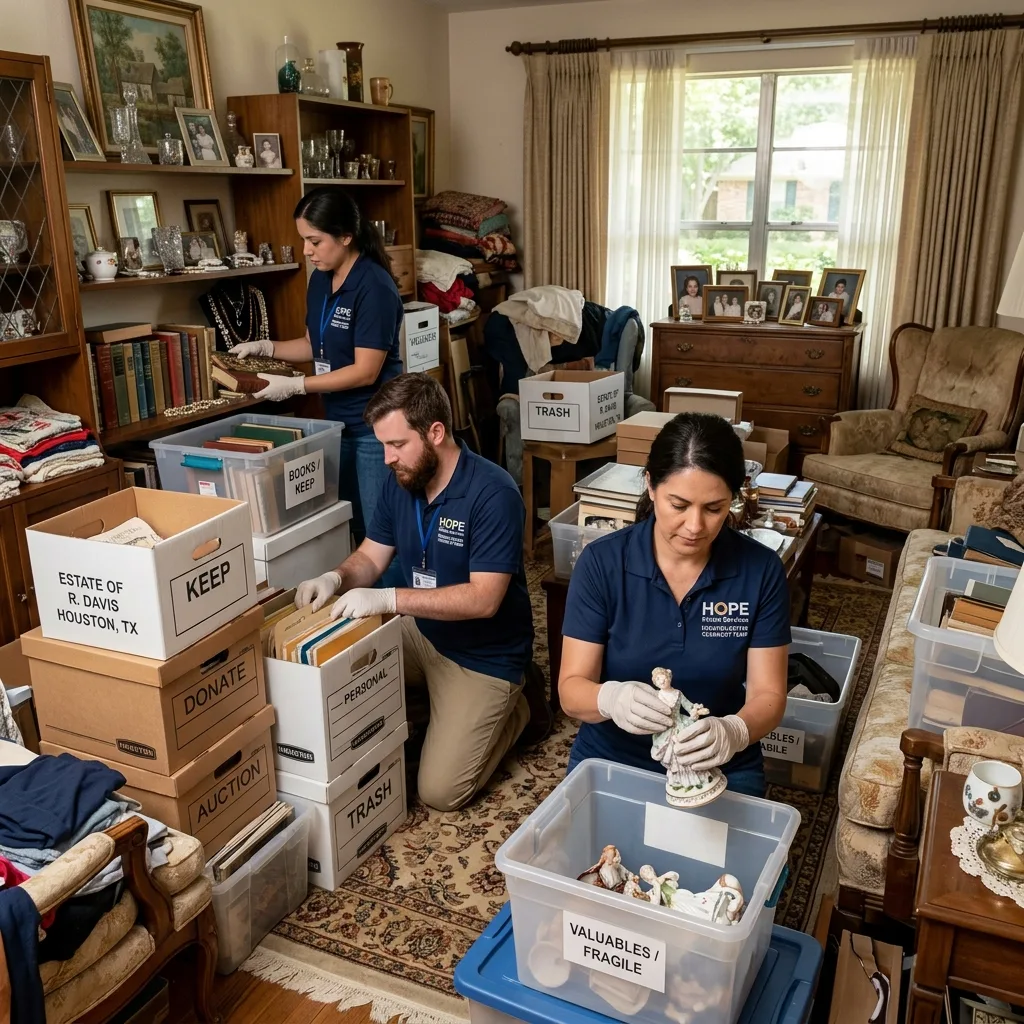
Professional crews are trained to examine items carefully rather than simply shoveling everything into disposal containers. A methodical approach ensures that important items are identified and set aside for the family.
Sorting and Categorization
As the cleanout progresses, items are sorted into distinct categories. Belongings that the family wants to keep are carefully packed and set aside. Items in good condition that can benefit others are separated for donation. Materials that can be recycled are diverted from the waste stream. Damaged, contaminated, or unsalvageable items are prepared for proper disposal.
This sorting process takes time but serves multiple purposes. It respects the memory of the deceased by ensuring their belongings are handled thoughtfully rather than indiscriminately discarded. It also reduces disposal costs and benefits the community through donations.
Houston Donation Resources for Estate Cleanouts
The Houston area offers numerous organizations that accept donated household goods, furniture, and other items recovered from estate cleanouts. Connecting usable items with people and families in need gives purpose to belongings that might otherwise go to a landfill.
Houston Furniture Bank
The Houston Furniture Bank provides furniture and household goods to families and individuals transitioning out of homelessness, fleeing domestic violence, or recovering from natural disasters. They accept donations of gently used furniture, appliances, and household items. For estate cleanouts with large volumes of usable furniture, the Houston Furniture Bank can be an excellent partner, as they have the capacity to handle significant donations and the items go directly to people rebuilding their lives.
Habitat for Humanity ReStore
The Habitat for Humanity ReStores in the Houston area accept donated furniture, appliances, building materials, and home improvement items. Revenue from ReStore sales supports Habitat for Humanity’s mission of building affordable housing in the Greater Houston community. Estate cleanouts often yield building materials, tools, and home fixtures that are perfect for ReStore donation.
Additional Houston-Area Donation Options
Houston’s extensive network of charitable organizations means there are outlets for nearly every type of usable item. Clothing can go to shelters and resale shops that support local nonprofits. Books can be donated to libraries or literacy organizations. Electronics in working condition can be directed to organizations that refurbish them for underserved communities. Kitchen items, linens, and household goods are always needed by organizations that help families establish new homes.
Navigating the Legal and Practical Considerations
Estate cleanouts, particularly for hoarded properties, involve several practical considerations that families should be aware of as they plan the process.
Probate and Authorization
Before a cleanout can begin, the person or entity authorized to manage the estate must give approval. This is typically the executor named in the will or the administrator appointed by the probate court. In Texas, if there is no will, the probate process determines who has authority over the estate’s assets, including the contents of the home.
Property Condition and Code Compliance
Hoarded homes sometimes have outstanding code violations or may have been the subject of complaints from neighbors or the homeowner’s association. In Houston and surrounding municipalities, addressing these issues may be part of the cleanout process. Bringing the property into compliance often requires not just removing accumulated items but also addressing any structural or maintenance issues that were neglected during the hoarding period.
Insurance Considerations
If the home will be sold after the cleanout, documenting the condition of the property before and during the cleaning process can be valuable. Photographs and detailed records of the work performed support any necessary insurance claims and provide transparency for potential buyers who may have questions about the property’s history.
Timelines and Expectations
Families often want to know how long a hoarded estate cleanout will take. The honest answer depends on several factors, including the size of the home, the density of the accumulation, the level of contamination present, and how much sorting and searching for valuables is required.
A small apartment with moderate hoarding might be cleared in two to three days. A large house with severe hoarding and biohazard conditions could require two weeks or more of full-time work. Professional crews can provide more accurate estimates after the initial assessment, and most work to accommodate family timelines when possible.
The Emotional Journey of Letting Go
For family members, a hoarded estate cleanout can be an emotional process that brings up complicated feelings about their relationship with the deceased. It is common to feel a mix of grief, frustration, relief, and sadness throughout the process.
Some families find it helpful to be present during the cleanout, while others prefer to step away and let the professionals handle the work, returning only to review items that have been set aside. There is no right or wrong approach. What matters is that the family feels supported and that the process moves forward at a pace that feels manageable.
Professional estate cleanout teams that work regularly with hoarded homes understand this emotional landscape. They approach the work with patience and empathy, recognizing that every box opened and every item examined carries the weight of a life lived. The goal is to help families through this difficult chapter with dignity and care, transforming an overwhelming situation into a manageable process that honors their loved one’s memory while creating a path forward.